

Beyond Digital | Field Trips
Amati Violin Shop
LongitudeSite organized a field trip to the Amati Violin Shop in Houston on December 15, 2025.
(See a reel of highlights.)
The group included students and alumni from Rice University and University of St Thomas, with majors and interests ranging from music composition, harp performance, biology, arts, to business. The conversations centered on craftsmanship and preservation in the arts.
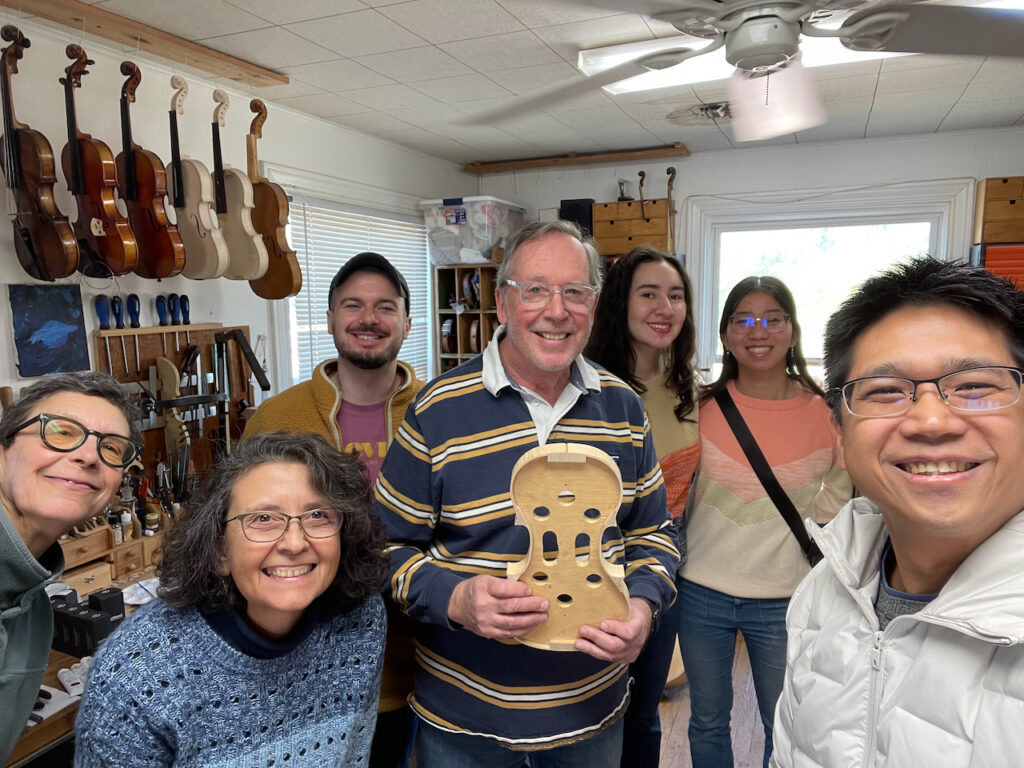
Featured left to right: Kate Marcus, Ipek Martinez, Shane Cook, Peter Shaw, Nora Navarro, Evalyn Navarro, Schubert Huang.
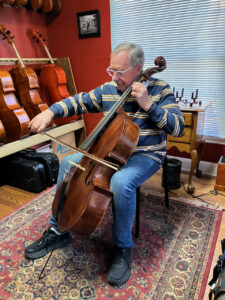
Peter Shaw, owner of the shop, an expert violin/cello maker and restorer, welcomed the group. He shared highlights of his journey from studying cello performance, playing the cello, to making violins after attending a violin making school in Salt Lake City.
He opened his shop in 1984 with another violin maker from Oregon who was looking to expand his operations to Houston. Eventually he bought out his partner’s share and moved the shop to its current location in the Rice Village. Over the years, he trained his son with all aspects of violin repairs and fine instrument making, who now works with him at Amati.
The group got to observe various types of violins and cellos, while Peter shared information of the types of woods used (spruce for the top and maple for the back and ribs), and explained the nuances of proper setup of new instruments – a time-consuming process that could sometimes take days, which include incorporating new bridges, fingerboards, and sound posts. Then, he led the group to his studio where he showed violins at different stages of their development and the tools used at each phase.
While answering various questions from the group, he made a mention of the Pernambuco wood used in making bows, which is found only in Brazil and listed as endangered species under the Convention on International Trade in Endangered Species. Brazilian authorities recently explored possibilities for upgrading Pernambuco’s protection. If it had passed, it could have created significant administrative burdens for musicians when crossing borders as it would have required acquisition of special permits.
.