Beyond Digital | Field Trips
Brockman Hall for Opera Costume Shop
LongitudeSite organized a field trip to the Brockman Hall for Opera Costume Shop located on Rice University in Houston on March 20, 2026. Reflections below is presented by Schubert Huang.
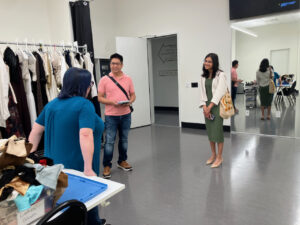
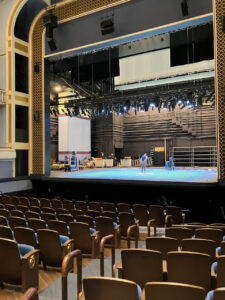
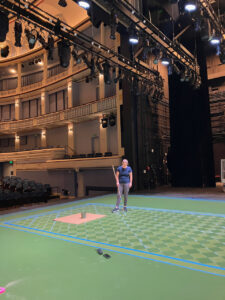
Last week we had the precious opportunity to visit Rice University’s Brockman Hall for Opera through Longitude Site program’s arrangement. We are extremely grateful for Rice University’s Ms. Jessie Mullins (Director of Operations for Opera) and Ms. Barbara Dolney (Wardrobe Supervisor) as the university’s opera department enters its busiest time preparing for the upcoming production of Verdi’s opera buffa “Falstaff”. We watched the stage being constructed and painted, the orchestra pit being expanded to accommodate a larger orchestra, and the metal and wood sets being constructed in the production shop, but we were let in on two fields that are so key to making operas possible, yet the magic is not always visible: costuming and stage managing.
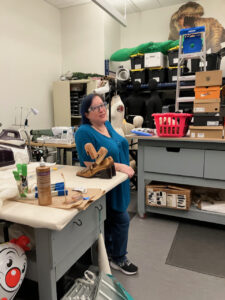
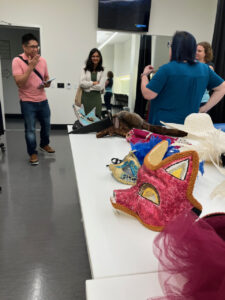
Considering how many hundreds of wardrobe parts and accessories that were purchased, rented, and made into an operation production, one would expect a wardrobe office to be chaotic, but not Ms. Dolney’s office. Everything is organized, compartmentalized, clean, and Ms. Dolney knows exactly where everything is – She has to, because we were amazed to learn that between acts of an opera performance, she checks the dozens of cast members and knows from head to toe if everyone is wearing the right pieces (which she has a spreadsheet listing all items a cast member should be wearing, with a picture of the look), and if not, her detective mode turns on until the right piece is found. She also adapts quickly when an opera’s director changes the production design concept halfway through an already-short planning timeline (she was only given 2 months to prepare for Falstaff) and becomes an inventor with the materials she has on hand when the necessity of acquiring certain period costumes alone blows her budget.
Ms. Dolney stressed the importance of working together with other departments, such as lighting designers, after learning from an incident where she designed beautiful green costumes, but colors of lighting turned them to ugly brown on stage. She also works together with the Wigs and Makeup department, and they decide the order of how an actor gets dressed – male roles usually have clothing that buttons up in the front, while female roles typically get dresses that zip up in the back. Even this difference can affect whether the wig gets put on before or after the costumes.
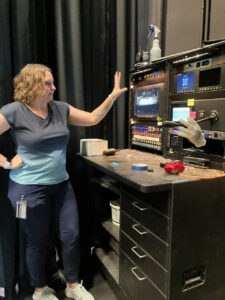
Speaking of working together, stage managing is its own fine craft that is highly choreographed and organized, and it starts when the theater is being designed and built. Ms. Mullins showed us how each room backstage (the wardrobe office, the principal’s dressing room, the ensemble dressing rooms, and the cast members check-in lobby) all have intercom speakers and monitors showing stage actions. When the stage manager needs an actor to move to upstage left, or when she needs the ensemble in the group dressing room to quiet down their chitchatting during a tender moment on stage, she has the ability to page each room, while wearing headphones and monitoring screens with a multitude of switches that link to all the rooms. “It’s all about communication”, says Ms. Mullins.
From a station off to the side of the stage, there is also a “Fly” station, for giving cues to the fly 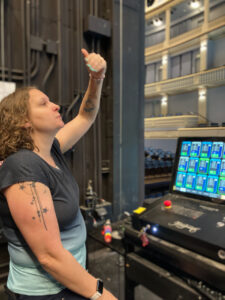 systems personnel when a curtain, a backdrop, and other parts of the scenery and lighting hung on poles above the stage must go up or down at various speeds. The fly systems, using ropes, pulleys, and counterweights, used to be all manually pulled like raising or lowering a flag, but the modern fly station machine can be programmed to do multiple actions at once. However, because all movements are cued to music or actions on stage, not only does the stage manager need to respond literally “on the fly”, but s/he also needs to be able to read music, speak the musical language, and know the music of the production.
This site visit’s revelation on the magic of opera production gave me these takeaways:
(1) An elevated appreciation for performing arts. It’s no longer just a ticket to a show, but someone selecting the right material for the peasant to wear on the stage, the right period of shoes for the duke, the right colors of jewelry for the princess; and someone getting the right people to be ready, cuing the right stage movements, and calling the shots at the right time – all for maximizing the intensity and the effectiveness of the musical drama for us theater lovers.
(2) Live performance managing is in some way similar to being a heart surgeon or an air traffic controller. The two theatrical magicians we met today explain what it takes: “It’s a LIVE thing. You need to be able to think on your feet; thrive on adrenaline and little sleep; have an instinct of things; can’t get frustrated; and keep in mind that there’s no fix in post [production],” because everything happens LIVE!
(3) What Ms. Mullins and Ms. Dolney do cannot be replaced by Artificial Intelligence. It’s all about communication and human connection, through theater, stagecraft and music.
Field trips like this and others made possible by Ms. Ipek and Longitude Site give participants material takeaways, like the above, that better our lives with new levels of appreciation, and new inspirations that we can pass onto other people. Go on the next Longitude Site’s field trip and you’ll get great new insights!